
How to clean a burnt paella pan
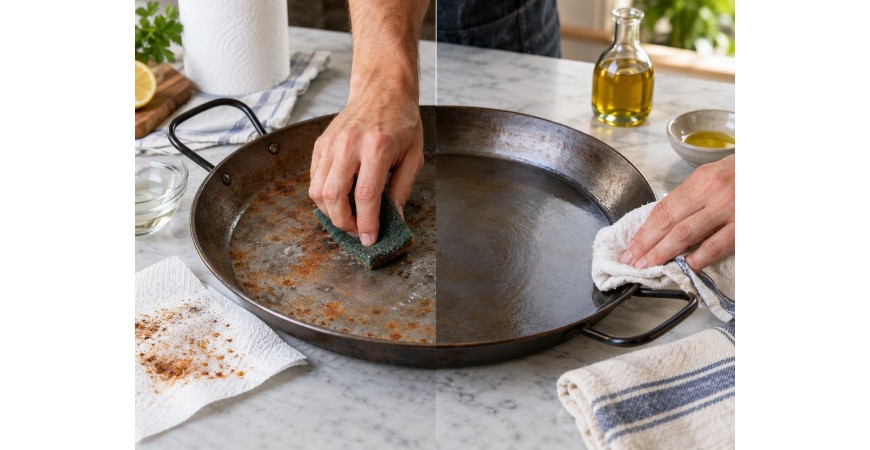
If a paella pan ends up with stuck-on rice, dark stains or even a layer of burnt food, this is fairly common, especially when cooking over high heat or trying to achieve a good socarrat. However, a burnt paella pan does not mean it is unusable. In most cases, it can be restored with proper cleaning and maintenance.
The most important thing is knowing what material your paella pan is made from, since a polished steel paella pan should not be cleaned in exactly the same way as an enamelled or stainless steel one. Using the wrong method can strip the protective layer, scratch the pan or encourage rust.
Below, we explain how to clean a burnt paella pan step by step, along with extra tips on removing any rust and caring for your pan after each use to keep it in good condition for years.
Why paella pans burn and how to prevent it
As the saying goes, prevention is better than cure. Burnt patches tend to appear when ingredients remain in contact with a particularly hot part of the pan for too long. This can happen while preparing the sofrito, when the stock evaporates completely, or during the final minutes of cooking, when the rice touches the bottom directly.
Sometimes a lightly toasted layer is exactly what we want. The socarrat is a desirable part of many rice dishes, but there is a big difference between gently caramelising the rice and burning it into a black layer stuck to the steel.
One of the main causes is uneven heat distribution. If the burner is too small for the pan's diameter, some areas get far more heat than others. This can also happen if the pan is not level, causing the stock to pool on one side, if the burner is too powerful, or if the stock runs out and the rice burns completely.
To prevent this, use a paella burner suited to the size of your pan, ensure the pan is level and control the heat throughout cooking. Pay particular attention during the last few minutes, when there is less liquid and the bottom can burn if left unattended.
What you need to clean a burnt paella pan
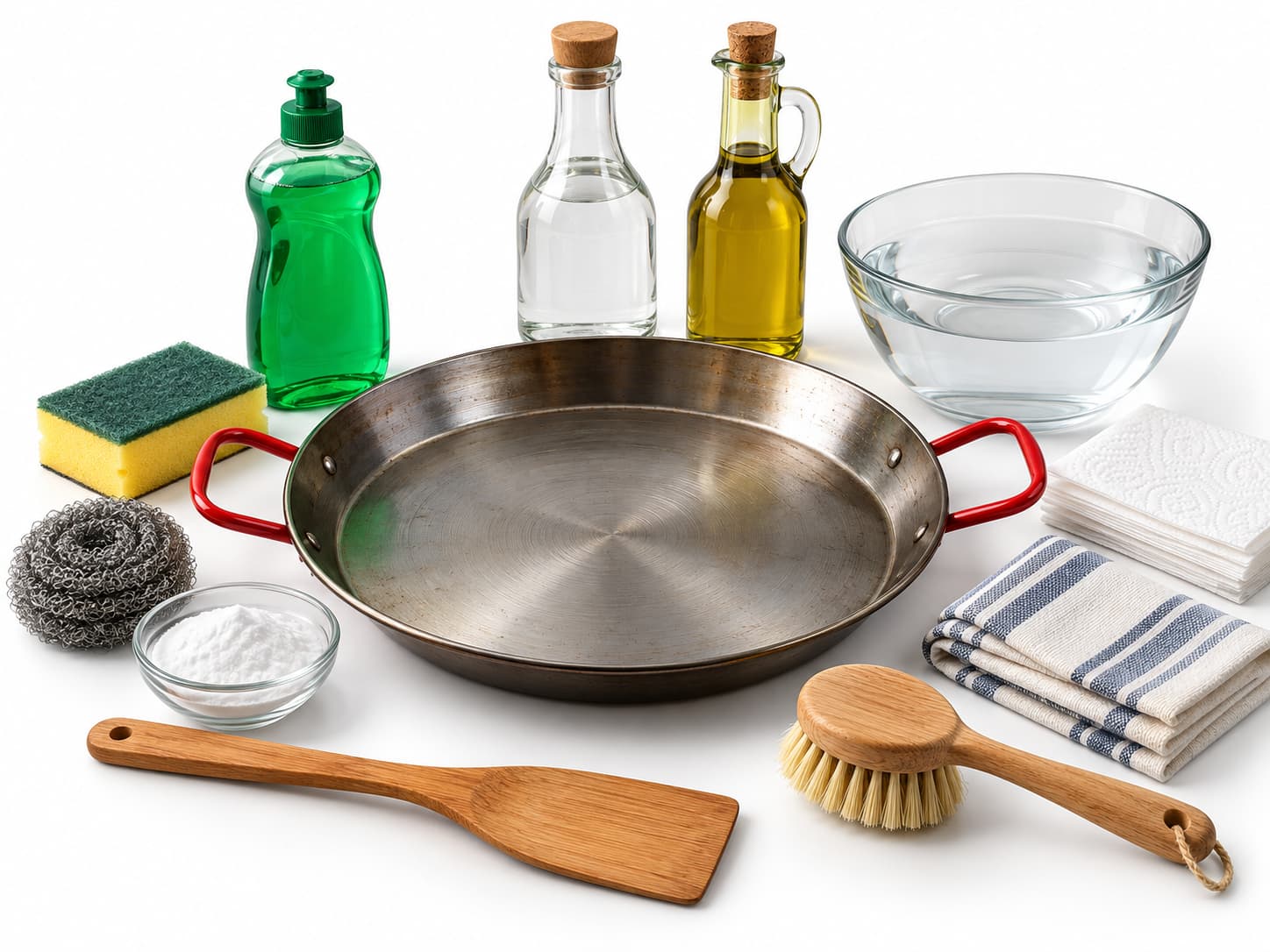
Before starting, gather a few basic tools and cleaning products. Most paella pans can be cleaned properly without harsh chemicals.
- Hot water.
- Mild washing-up liquid (we also recommend using Asevi)
- A sponge or scouring pad suitable for the pan's material.
- A wooden or plastic spatula to remove stuck-on food.
- Baking soda for particularly stubborn marks.
- Vinegar, mainly for certain rust-removal treatments.
- Kitchen paper or a clean, dry cloth.
- Vegetable oil to protect polished steel paella pans after cleaning.
Whenever possible, avoid starting with abrasive products or metal tools. Gradual cleaning is usually enough and helps preserve the surface.
How to clean a burnt paella pan according to its material
The method varies considerably depending on the material. Before applying any treatment, check whether you have a polished steel, enamelled or stainless steel paella pan.
Polished steel or carbon steel paella pan
Polished or carbon steel paella pans are probably the most traditional. They distribute heat very well, but have one important characteristic: they can rust if left wet.
If rice or food is stuck to the pan, first partly fill it with hot water and leave it for a few minutes. If the residue is firmly stuck, bring the water to the boil in the pan with a few drops of detergent for around 15–20 minutes. This softens the residue and makes it easier to remove from the bottom.
Then remove the food using a wooden spatula or suitable scouring pad. You can use washing-up liquid to remove grease, rinsing thoroughly afterwards.
The most important step comes after washing: the paella pan must be dried immediately after cleaning. The easiest way is to dry the surface with a cloth or kitchen paper. Make sure it is completely dry or it may rust.
Once dry and cool, apply a very thin layer of vegetable oil to the entire inside surface with kitchen paper. This film protects the steel from atmospheric moisture and greatly reduces the risk of rust during storage.
Enamelled paella pan
Enamelled paella pans have a protective coating that makes maintenance easier and prevents direct exposure of the steel to moisture. They therefore usually need less care after washing.
For burnt-on residue, add hot water and a few drops of detergent and leave for several minutes. Then use a sponge or a non-aggressive scouring pad to gradually remove the residue. Thanks to its enamel coating, you can also leave the pan to soak to soften burnt food.
For these pans it is particularly important to avoid hard knocks and utensils that can damage the enamel. If the enamel chips, the underlying steel may become exposed and start to rust.
Once clean, rinse the pan thoroughly and dry it before storing.
Stainless steel paella pan
Stainless steel is highly corrosion-resistant and requires less maintenance than polished steel. However, burnt food can still stick firmly if the temperature gets too high.
To clean a burnt stainless steel paella pan, start with hot water and detergent and let the residue soften. If it remains stuck, add water and a little baking soda and heat gently for a few minutes, or leave it to soak.
Once cool, rub the affected areas with a suitable sponge until the residue is removed. To preserve the finish, avoid very abrasive products and pads that may cause deep scratches.
Although stainless steel resists rust, you should also rinse and dry the paella pan thoroughly after washing, particularly to prevent mineral deposits from the water.
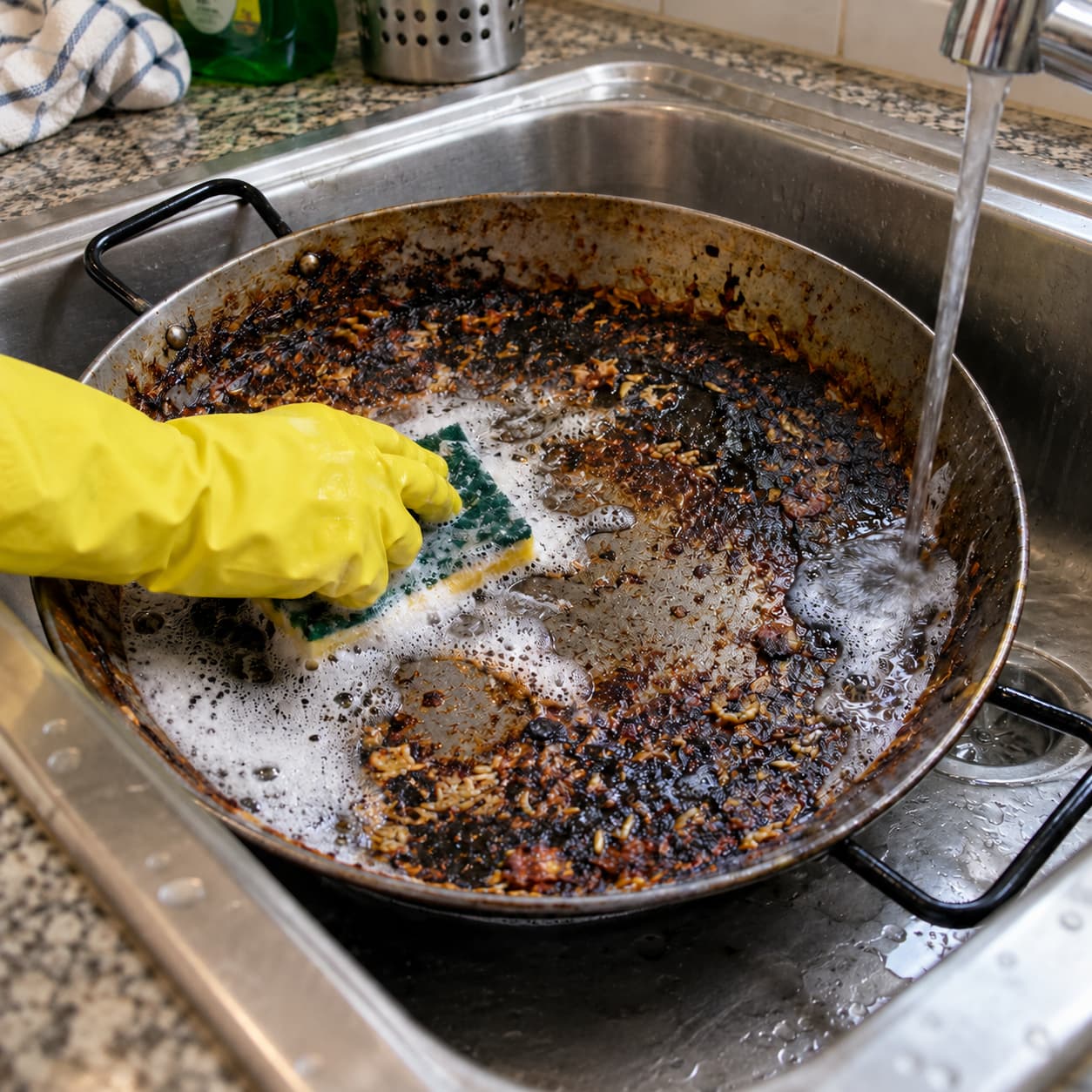
Home remedies for cleaning a badly burnt paella pan
A heavily burnt pan can seem difficult to restore, especially when rice and other ingredients have become completely charred and stuck to the bottom. However, before using aggressive cleaners, there are several home remedies for cleaning a burnt paella pan that can help remove the dirt and restore its surface.
Bear in mind that some of these methods must be used with care; furthermore, not all paella pans should be cleaned in the same way. The best method depends on whether the pan is polished steel, enamelled or stainless steel, as explained above.
1. Hot water and soap: the first remedy to try
Before trying anything else, we recommend softening burnt-on food with hot water and washing-up liquid.
Add enough water to cover the burnt area along with a few drops of soap. With an enamelled or stainless steel pan, you can leave it for approximately 20 to 30 minutes.
Avoid soaking polished steel paella pans for too long. It is better to add water and go straight to the heating method described below.
Once the residue starts to soften, gradually remove it with a wooden or plastic spatula.
Do not try to scrape off a thick layer of charred food while it is dry. Softening it first makes removal much easier and reduces the risk of damaging the surface.
2. Baking soda for a badly burnt paella pan
Baking soda is one of the most widely used home remedies for cleaning burnt cookware.
You can use it as follows:
- Lightly dampen the burnt area.
- Sprinkle baking soda over the surface.
- Add a little water to form a paste.
- Leave it to work for approximately 30 minutes.
- Rub gently with a sponge or scouring pad suitable for the pan's material.
If the residue is especially stubborn, you can also add water and one or two tablespoons of baking soda directly to the pan and heat it for a few minutes.
The heat will soften the dirt and help loosen the charred food.
3. Cleaning a burnt paella pan with white vinegar
White vinegar is another common ingredient in homemade cleaning solutions.
You can make a simple mixture using:
- 1 part white vinegar.
- 2 parts water.
Pour the mixture over the burnt area and leave for a few minutes. For extra effectiveness, you can gently heat it in the paella pan.
Then pour out the liquid and wash the pan with soap and water to remove any dirt and vinegar smell.
For polished steel pans, avoid leaving acidic liquids or mixtures on the surface for long periods and dry immediately afterwards.
4. Does mixing baking soda and vinegar work?
The combination of baking soda and vinegar is probably one of the best-known home remedies. When mixed, they create a fizzing reaction that may help loosen some surface residue and make cleaning easier.
To use this method, sprinkle baking soda over the burnt area and then add a little vinegar.
However, do not expect the foam alone to remove a completely charred layer of food. For severe burning, it is usually more effective to soften the residue with hot water first and then use baking soda and gentle scrubbing.
5. Lemon and salt for lighter stains
Another traditional option is to use lemon and salt.
Sprinkle a little salt on the affected area, cut a lemon in half and use it to rub the surface gently.
This can help with superficial stains or residue, but it is generally not the best option for a completely charred paella pan.
6. Heating water in the pan to loosen burnt food
When a pan has a thick layer of charred rice or food, one of the simplest and most effective methods is to heat water directly in the paella pan.
Add enough water to cover the burnt areas and place the pan over the heat.
Heat the water for approximately 10 to 15 minutes. A vigorous boil is unnecessary; the aim is for heat and moisture to soften the stuck-on residue.
Then let the pan cool enough to handle safely and remove the food with a wooden or plastic spatula.
If any dirt remains, finish cleaning with soap or baking soda.
How do you clean a completely black paella pan?
If the pan is badly burnt and almost its entire bottom is black, the best approach is to clean it gradually rather than trying to remove all the charred material in one go.
Follow these steps:
- Add enough water to cover the burnt areas.
- Heat the water for 10 to 15 minutes.
- Remove the pan from the heat and let it cool.
- Use a wooden or plastic spatula to remove all loosened residue.
- Apply baking soda to any black areas still stuck to the pan.
- Leave it for a few minutes.
- Rub with a sponge or scouring pad suitable for the pan's material.
- Repeat if any charred residue remains.
It is better to repeat the process several times than to use overly aggressive tools that could permanently damage the pan.
What should you avoid when cleaning a burnt paella pan?
A stubborn black layer may tempt you to scrape it off with any available tool. However, some methods may cause more damage than the burning itself.
- Do not scrape the surface with knives, screwdrivers or sharp metal objects.
- Do not use metal scouring pads on enamelled pans.
- Avoid highly corrosive chemicals.
- Do not leave a polished steel paella pan submerged in water for hours.
- Do not store a polished steel paella pan while it is still wet.
- Do not apply too much oil after cleaning. A very thin film is enough.
Summary of home remedies for a burnt paella pan
| Method | Light burning | Severe burning | Polished steel | Enamelled | Stainless steel |
|---|---|---|---|---|---|
| Hot water and soap | Highly recommended | Recommended | Yes, without prolonged soaking | Yes | Yes |
| Baking soda | Yes | Highly recommended | Yes | Gently | Yes |
| Diluted vinegar | Yes | May help | Without prolonged exposure | Yes | Yes |
| Baking soda + vinegar | Yes | Limited effectiveness on its own | With caution | Gently | Yes |
| Lemon and salt | Yes | Not very effective | With caution | Gently | Yes |
| Heating water in the pan | Yes | Highly recommended | Yes | Yes | Yes |
What if the paella pan cannot be restored?
A badly burnt paella pan does not necessarily need replacing. In most cases, charred residue can be removed with patience using the methods above.
However, if there is severe warping, deep corrosion or significant loss of enamel, it may be worth replacing it.
And of course, prevention is better than cleaning. To avoid another completely black bottom, read our guide to how to prevent burnt paella and its main causes.
Frequently asked questions about cleaning a badly burnt paella pan
How do you remove black burnt marks from a paella pan?
The most effective approach is to soften the black layer with hot water for a few minutes. Then remove the residue with a wooden or plastic spatula and use baking soda for tougher stains. If burning is severe, repeat the process rather than scraping the surface aggressively.
Can baking soda be used to clean a paella pan?
Yes. Baking soda can help remove burnt food and stubborn stains. Make a paste with a little water or add it to water heated inside the pan.
Can a burnt paella pan be cleaned with vinegar?
Yes. White vinegar diluted with water can help loosen some residue and stains. However, it is usually not enough on its own for a thick layer of charred food. Avoid leaving vinegar on polished steel for long periods.
Can I leave a burnt paella pan soaking overnight?
It depends on the material. Enamelled or stainless steel pans can be soaked to soften residue. However, polished steel paella pans should not be soaked for many hours, as moisture can cause rust.
Can I use a metal scouring pad?
It is not advisable on enamelled pans, since it may damage or chip the enamel. Polished steel can withstand more intensive cleaning, but it is always best to soften residue first. On stainless steel, avoid excessive abrasion to preserve the finish.
How do I prevent a polished steel paella pan from rusting after cleaning?
Dry it completely after washing. Then spread a very thin film of vegetable oil across the surface with kitchen paper before storing. This helps protect the steel from moisture.
Can a badly burnt paella pan be restored?
In most cases, yes. A black bottom does not necessarily mean the pan is damaged. Charred food can usually be removed with hot water, baking soda and gradual cleaning. Consider replacement only in cases of major structural damage, deep corrosion or substantial enamel loss.
How to remove rust from a paella pan
If your paella pan has rusted after cleaning, follow our guide to "how to remove rust from a paella pan" to make it look like new again.
How to keep your paella pan clean after each use
Cleaning correctly after each use is the best way to prevent stubborn build-up and extend the life of your paella pan.
We recommend reading our article "how to clean my paella pan" for tips on getting it perfectly clean.