

Why is paella eaten on Thursdays in Spain?
Every culture has its own details and traditions, concepts or customs, some of them well documented and others so deeply rooted that nobody even stops to wonder why they exist.
A common tradition in Spanish restaurants is that Thursdays are paella day, but why is that? Did all the restaurants agree on it, is it something customers demanded, or is there a rice mafia encouraging this particular day to sell more?
The truth is a little more complicated than we might think, so let's take a closer look.
Where does the tradition of eating paella on Thursdays really come from?
If you have ever checked the daily menu of a bar or restaurant on a Thursday, you have probably come across a familiar sight: paella, rice or a similar dish among the menu options. The association between Thursday and paella is so widespread in some parts of Spain that it may seem like a tradition with a perfectly defined origin. However, the reality is much more curious.
There is no single, fully documented historical explanation that can establish exactly why paella began to be served specifically on Thursdays. Over the years, different theories have emerged relating to domestic customs, restaurant organisation, food supplies and even some well-known legends.
It is also important to distinguish this daily-menu custom in bars and restaurants from the Valencian tradition surrounding paella. In Valencia, paella has historically been much more closely associated with Sundays, celebrations and family gatherings. Therefore, when we talk about the famous “Thursday paella”, we are mainly referring to a restaurant tradition that eventually spread to different parts of Spain, with particular prominence in Madrid and Barcelona.
The most widespread theories about the origin of this tradition
Precisely because there is no definitive answer regarding Thursday paella, several explanations can be found. Some are quite reasonable when viewed in the context of the social customs of previous eras, while others are closer to popular legend.
The domestic staff's day off in wealthy households
One of the most frequently repeated theories places the origin of this tradition in the wealthy households of large cities. According to this explanation, Thursday was traditionally one of the days when some domestic staff could take the day off, including the person responsible for preparing meals.
From here, there are two versions. The first claims that, before enjoying their day off, cooks would leave the sofrito and necessary ingredients prepared so that the following day all that was needed was to add the rice and finish the dish. This allowed the family to have a meal that was relatively easy to complete.
The second version is particularly interesting when explaining how this custom may have appeared in restaurants. Without the staff member who normally cooked at home, some families would take advantage of Thursday to eat out. Restaurants may have responded to what became a routine by offering more appealing dishes than usual, including different rice dishes and paellas.
Over time, the repetition of this pattern may have helped associate Thursday with rice dishes until it became a recognisable feature of weekly menus.
The strategy of restaurants to attract customers during the week
Another explanation is directly related to the restaurant industry. Thursday is close to the end of the working week, but still before the usual weekend rush. Offering a particularly attractive dish could therefore have served as a way to encourage customers to eat out.
Paella offered several interesting advantages for restaurants: it was a well-known dish, it could be prepared for many diners and it was visually appealing when made in large quantities. Turning Thursday into a small “rice day” also helped create a routine among regular customers.
Once certain restaurants began offering paella on that particular day and customers started expecting it, other establishments may have adopted the same practice. In this way, what may originally have been a commercial decision eventually developed into a popular daily-menu tradition.
Using up ingredients before the weekly Friday shopping
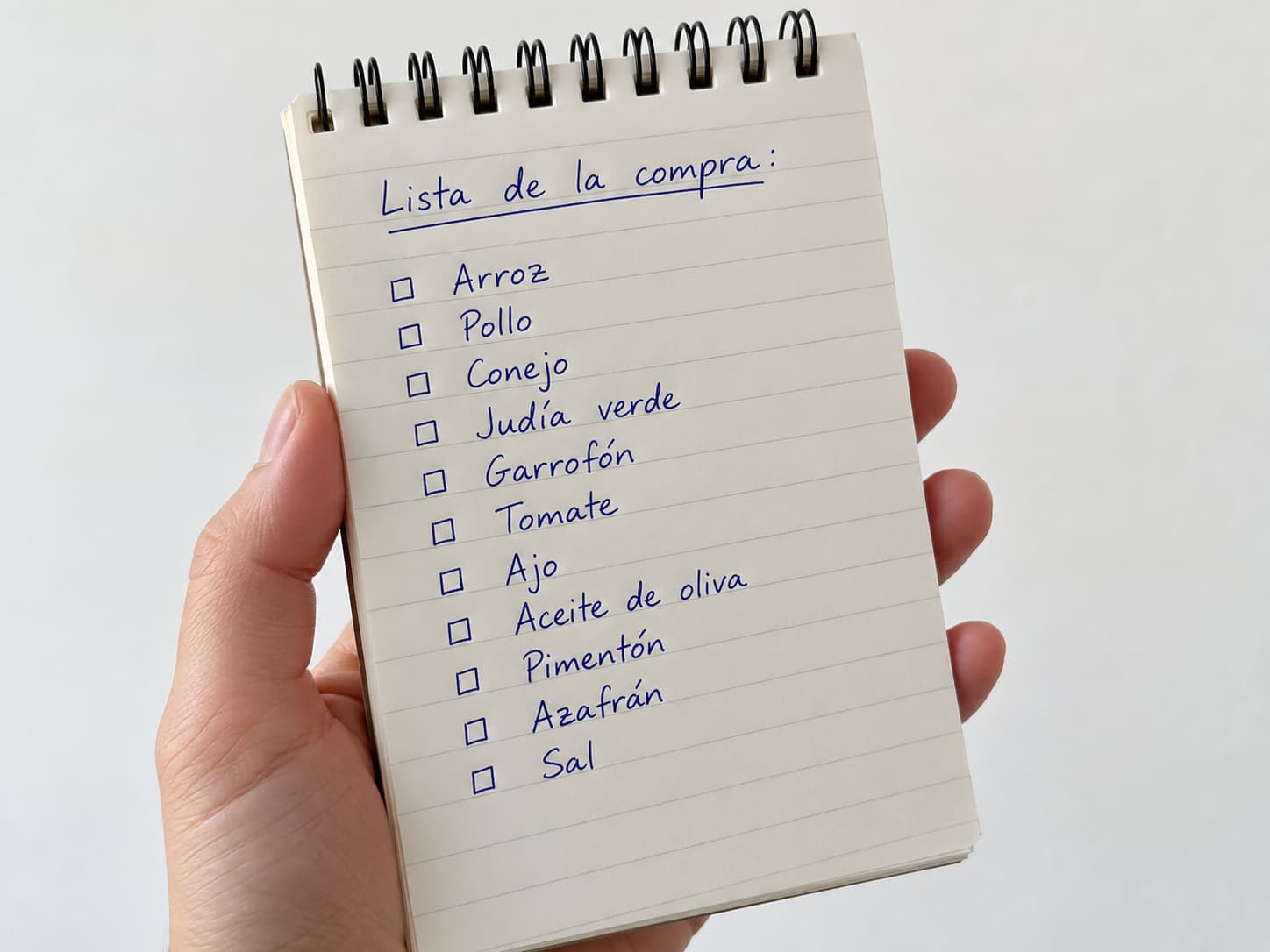
Another of the best-known theories has a much more practical origin: using the ingredients already available in the kitchen before buying new supplies.
According to this explanation, many establishments traditionally restocked towards the end of the week. By Thursday, small quantities of vegetables, meat, fish or other products used during the previous days might still remain.
Rice dishes provided a practical way to use different ingredients without wasting them. This may have led to the idea of preparing rice or paella on Thursday, just before restocking for Friday and the weekend.
There is even an almost opposite theory related to fish: in certain inland cities, such as Madrid, it has been said that fish caught at the beginning of the week took several days to be transported and distributed, meaning that Thursday could coincide with its arrival. In this case, paella would not have been used to make the most of older ingredients, but rather to use freshly delivered fish.
The existence of such different versions demonstrates how difficult it is to establish a single origin for this tradition.
The legend of Francisco Franco and his incognito visits
This is probably the best-known explanation and, at the same time, one that should be treated with particular caution.
The legend says that Francisco Franco was fond of paella and used to go out to eat on some Thursdays in Madrid. Supposedly, he chose the restaurant without announcing in advance where he would go, so restaurants in the capital began preparing paella that day in case he happened to visit.
According to this story, over time the custom would eventually have spread from Madrid to the rest of Spain.
It is certainly an eye-catching explanation and has been repeated countless times, but there is not enough historical evidence to consider it the true origin of Thursday paella. It is therefore more appropriate to regard it as a popular legend that arose around a tradition that probably already had much more complex social and gastronomic explanations.
The Valencian agricultural origin: Thursday as a day of rest
There are also explanations that attempt to trace the origin of Thursday paella back to the Valencian Huerta, the agricultural environment closely connected with the origins of paella. However, in this case it is particularly important to distinguish historical facts from later interpretations.
Thursday does indeed have a very old connection with Valencian agricultural life. For centuries, the Water Tribunal of the Plain of Valencia has met every Thursday to resolve disputes relating to the use of water from the irrigation channels supplying the Huerta. Farmers, irrigation representatives and other people connected with agriculture traditionally travelled to Valencia to deal with these matters.
According to one popular theory, these meetings brought farmers from different towns into the city and, once the day's matters had been settled around midday, many stayed in Valencia for lunch. Some eating houses may then have offered rice dishes and paellas suited to the tastes of customers closely connected with the Huerta.
This story has sometimes been simplified by claiming that Thursday was the day of rest for Valencian farmers. However, there is not enough evidence to establish that a weekly agricultural rest day specifically devoted to Thursday existed on a widespread basis.
Which theory has the greatest historical weight?
After reviewing the different explanations, it is tempting to look for a single theory that definitively solves the origin of the tradition of eating paella on Thursdays. However, the available documentation and evidence do not allow us to identify with certainty a specific moment, city or cause from which the custom began.
Among the most frequently repeated explanations, the theory concerning the domestic staff's day off is particularly consistent with the social customs of certain historical periods. If some families usually ate out when the person responsible for cooking had the day off, it is reasonable to think that restaurants may have taken advantage of this greater demand by offering special dishes. Even so, there is a lack of documents or references in books proving that this practice was the real starting point.
Something similar occurs with the theories concerning restaurant supplies and the use of leftover ingredients. They make gastronomic sense, but it is difficult to establish that they were widespread throughout the country or directly linked to the choice of Thursday.
The story of Francisco Franco, meanwhile, is probably the most striking, but also one of the hardest to prove. The lack of documentation or references in writings from people close to him confirming that his supposed Thursday visits caused restaurants to change their menus makes it advisable to regard it mainly as a popular legend that later became associated with an already existing tradition.
Therefore, rather than looking for a single cause, it is probably more accurate to think that different social and restaurant customs reinforced one another. What may have started as a local practice was repeated over generations until it became something that many customers still expect to find when looking at a daily menu on a Thursday.
Why restaurants still serve paella on Thursdays today
Whatever its origin, the association between Thursday and rice dishes has survived many of the changes experienced by the Spanish restaurant industry. Although restaurants today have better preservation systems, faster supply chains and a much wider range of dishes, it is still common to find paella or rice as the dish of the day on Thursdays.
Today's explanation probably has less to do with domestic needs or food supplies and much more with something simple: the tradition works. Customers know the custom, some specifically look for a rice dish that day, and many establishments have decided to keep it as part of their weekly offering.
Paella as a profitable menu dish for large numbers of diners
Rice dishes offer several advantages for a restaurant serving daily menus and needing to cater for many diners within a relatively short period of time.
A paella can be prepared in substantial quantities using a single preparation for numerous servings. It also allows much of the work to be organised in advance by preparing the sofrito, stock and ingredients that accompany the rice, making it a practical dish to feature regularly on a daily or set menu.
There is also the question of customer perception. Compared with other common menu dishes, paella can be perceived as something more special or associated with a relaxed, shared meal. This combination of being able to produce many servings while remaining attractive to diners helps explain why rice dishes continue to have such a strong presence in restaurants.
A tradition that has become a commercial attraction
After decades of repetition, the concept of “Thursday paella” has itself become a small commercial attraction.
A restaurant that serves the same rice dish every Thursday creates an easily recognisable routine. Regular customers know what they will find that day and may even organise their meals according to the menu. It is the same principle behind other weekly gastronomic traditions found in bars, restaurants and canteens.
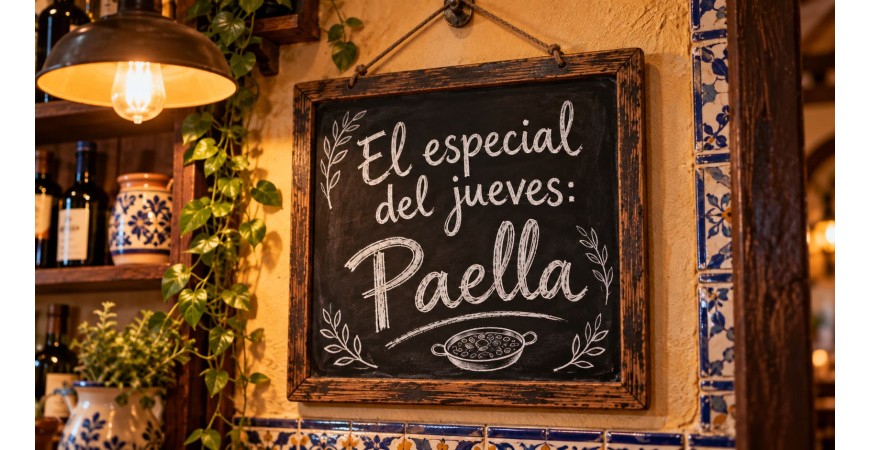
Maintaining a well-known tradition also makes it easy to communicate. Signs, chalkboards and social media posts can announce “Thursday paella” without much explanation: customers immediately understand what is being offered.
In this way, a custom whose origins are still debated has ended up creating its own continuity. Restaurants serve paella on Thursdays because customers expect to find it, and customers expect it because restaurants have been serving it for decades.
Is the tradition the same throughout Spain?
No. Although talking about Thursday paella may give the impression that it is a tradition followed uniformly throughout the country, its presence varies considerably depending on the city, region and type of establishment.
The association is particularly recognisable in the daily menus of certain large cities, where restaurants have organised their weekly offerings around specific dishes for decades. Madrid is probably one of the places where the expression has become most popular and where some of the legends surrounding its origin have also developed.
In other parts of Spain, paella may be found on Thursdays without there necessarily being such a strong tradition. It is also common for a dish simply advertised as “paella” to actually be some type of rice with meat, fish, seafood or vegetables adapted to the cuisine and customers of each establishment.
The Valencian case deserves separate consideration once again. Although it is naturally possible to find restaurants serving paella any day of the week, within Valencian family tradition Sunday has historically carried much more significance than Thursday.
Valencian paella is closely linked to family gatherings, festivals, celebrations and meals in which cooking itself forms part of the occasion. For many Valencian families, therefore, talking about paella is more likely to evoke a Sunday meal gathered around a freshly cooked paella than a restaurant's Thursday daily menu.
Paella on Thursdays: real tradition, urban myth or both?
So, is it true that people in Spain eat paella on Thursdays? The most appropriate answer is probably: yes, but with some nuances.
The custom is real. For decades, numerous bars and restaurants have included paella or another rice dish on their Thursday menus, and the practice can still be found in many establishments today.
What is much more difficult to prove is why it began. Among the many explanations, theories and popular legends, some seem more plausible than others and several may contain a degree of truth, but none has enough evidence to explain the birth of the tradition on its own.
Thursday paella can therefore be considered both a genuine gastronomic custom and a tradition surrounded by myths. What is truly interesting is seeing how a practice whose origin nobody can determine precisely has managed to survive for generations.
Perhaps that is precisely part of its charm. While we continue discussing where it began and why it persists, every Thursday paellas and rice dishes continue to appear on tables in restaurants, bars and some homes.
And in the end, regardless of which theory is correct, the tradition has achieved something difficult to dispute: giving many people one more excuse to gather around a good paella.